Thursday, October 31, 2013

Profitable herbs for aquaponics

   Well now your growing some plants and raising fish, but wish that you had enough money to  build and grow more. Obviously we know we can sell off some of our fish and even our lettuce, but everyone grows lettuce and most that have aquaponics have tilapia, check craigs list to see if anyone is selling tilapia, if not jump on it, it can be a gold mine.

  But I want to go over a few herbs that you can grow that you may already be growing or can easily grow that can make a small profit if you can find a buyer.

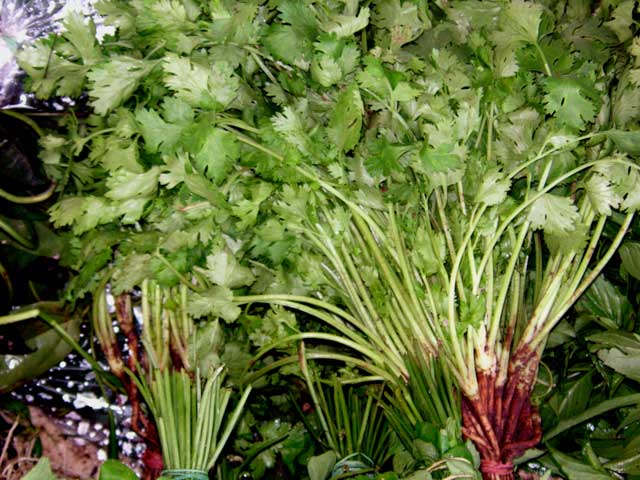
Cilantro is an excellent source of potassium, is low in calories, and is good for the digestive system. Expect to sell a good portion of this at the Saturday market. a lot of the latin restaurants will buy fresh Cilantro also. These are easy to grow in flood and drain systems and self watering buckets (dutch buckets) systems.

Make up your own salsa and sell that as well.


Basil is my favorite to grow! It is so easy and gives off a great aroma. I use it in everything I cook, and fresh basil makes the best pesto. Besides making every dish just fabulous, it also has great medicinal properties. It helps treat common colds, headaches, stomach disorders, inflammation, heart disease, various forms of poisoning, and malaria.
 Growing Basil is easy in flood and drain and I have good luck with it in rafts also. It supposed to help keep the flys down too, but havent had that kind of luck with it.  Keep fresh plants to harvest.

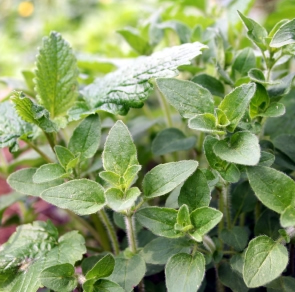
Oregano has a distinguish flavor that one just has to have if they are cooking Italian food. Fresh Oregano or dred can be sold to health food shops, since it is good for so much healthy properties, including colds and viral infections, digestive upsets, pain relief, and respiratory problems. Warming oregano can also be used to bring on menses and ease painful menstruation, even cancer.
I personally use the oil to keep from getting colds, just add a few drops to an ounce of water and drink, nasty as all get out but works.
It also works in flood and drain systems. I haven't tried it in float systems but would assume that it would do great.

Chives are a steady seller. These will start to germinate after a week or so. And unlike basil, these can actually do quite well in cooler weather.
I like to use chives in place of onion on a regular basis.
Every restaurant will use these if you can give a fair price on them. simple to grow in most mediums, and will multiply without assistance from you. Also puts on a pretty lavender flower.


Chamomile can all be traced to its effects on the nervous system and digestive system, as well as its anti-inflammatory and antibacterial properties. Works great for a sleep aid and even has a lot of uses for skin and hair care. The market for this is easy to get into. Cant find it at the super market and everyone has an illness that this can help. I like it to help sleep, it seems this has been a small problem of mine. Grows in a flood and drain system, but should be given a lot of space.
Parsley is  a great cash crop because it grows so well. It is used in many dishes. Parsley leaves and root are high in iron content and rich in vitamins A, B, C and trace minerals. Parsley adds color and aids digestion of the foods we eat and acts to prevent gas and bloating. Its just an all around good herb. And can be grown in both flood and drain, or raft, or if you choose, it can be grown in a bucket system.

Catnip is great to sell at farmers markets. Most everyone has a cat. You can sell the whole plant, or dried in individual bags. But also have to let your customers know how good it is for them. It is a soothing sedative for humans. It has been known to provide pain and stress relief and to also help with flu and cold symptoms. Catnip leaves contain considerable quantities of vitamins C and E, both excellent antioxidants.  Grow these in a rock or shell medium.  Makes great Christmas gifts and can be sold at craft fairs as well as the weekend market.

Lavender Is usually done on a more commercial basis, but if you have a local florist or someone that makes home remedies using honey and such, this is a popular product. It can be added to tea and has a lot of medicinal gifts. Soaking in a lavender scented bath relaxes away mild depression and anxiety and may even lower high blood pressure and improve circulation. Helps with sleep aid also. Great to grow in an extra bed that has a lot of room, or you can lace these randomly in your other beds.

   When picking out herbs or plants to sell, try to use what people are familiar with. Exotic plants do good if you can find the right market. But some folks like to have what they are used to or what their grandmother used in her kitchen. Start small and investigate what you are growing. Its like Vanilla beans is a great cash crop, but they take so much care and time, that its only worth it if you have a dedicated green house just for that. So keep it simple and get ready to make a lil profit. and live a healthier life for a bonus. 

   If there is a plant that you think is a great profit plant, let me know, and would love to post it.

Please leave a comment and subscribe!
Thanks


Raising crayfish in Aquaponics

     My experience with using crawfish (or cray fish depending where your from) has mixed feelings.
Now I dont for some reason have any pictures of my set up but let me explain my pros and cons about raising Crawfish.

I was doing an experimental set up with a flood and drain system with a small deep well attached.

 not wanting to use any fish because of the cooler temps in NW Arkansas that time of year I decided on local creek cawfish. First lets just note that when catching these quick lil buggers it would help if you had a net. But caught about 20 small to medium crawfish and also a few tadpoles (different story) and one of those bottom sucker fish, and also 3 snails.
  
    I placed all in a small styrofoam cooler without a lid and placed them in the back seat of the truck. That was mistake number one, when I got home, half of the crawfish had escaped and were all over the truck. Took about an hour to find them.

   My patio is inclosed with a pool dug into the ground. I built everything the same level an currently pouring concrete around the pool.  Everything is closed in.

    Now to the point. Once placing the crawfish in the aquaponics. I built a wire box from old chicken wire so that they can climb on and also cut some pvc to place on the bottom for privacy.

   The next day, I discovered 2 crawfish in my pool, now remeber it is cool out, so off I go with snorkle gear and catch the 2 and place them back in the 75 gallon tank.
I thought well that was odd couldnt really see how they could climb out.
Next day same thing, but 4 this time. back with the snorkel gear to chase the crawfish down.

    So I watched them for a while noticed that when the water drains from the grow bed and the water table rises that its only 3 inches from the top, so I took out a few gallons until it was 6 inches thinking maybe that would do.

   Next morning nothing was in the pool, I was happy, until the next morning, 3 more were in the pool and was on its way. starting to almost enjoy the cold water swim now, but not quite.

    I realized then that they were climbing up the folded part of the liner. after a month of all this and modifications I gave up and brought them back to the creek, it was time to use my pool and didnt need them in it.

    But to the good part of it all. The natural habitat worked very well. I even dipped up duck weed from a local pond. The water stayed clear and I fed the crawfish fish pellets and they really loved the sweet feed that I still had from when I had a pig. I enjoyed having them and watching the lil habitat work. The plants seem to well too, the basil grew tall and had some cabbage taking off.
I think I would like to do this again but with a tank that has slick sides.
   The nutriets from the habitat looked to be balanced even though I never took any test.

So if you see a few crawfish in the creek and have a container that will hold them, do grab some, very beneficial, But if you have a pool close by and they can escape, well its best to just leave them where they are, lol

Oh! and about the tad poles, well they do grow! and it is so awesome to watch them get their legs and
see them change their heads and then next you see them sitting on the side of the tank and jumping, and then..... well then you see them under your lawn furniture are taking a dip in your pool. So maybe not the best idea, but it was fun.
If you have had any experience of raising craw-fish in aquaponics, please leave a comment, I would like to know how to do it without sharing my swimming pool.

Monday, September 2, 2013

Worms in Aquaponics

When I first heard of putting worms in Aquaponics, I just couln't understand how.

I just assumed that the worms would drown, after all when it rains hard you see worms coming to the surface all the time, so I thought they were drowning, but in fact the water was just pushing the oxygen out of the soil, so the worms had to surface to breath.

As long as you are producing plenty of oxygen whether it be from aeration stones or flooding and draining your beds, then the worms do well. I have even seen worms in the tank, up against an aerator doing well, even very lively.

So now that we can say that worms can survive, why would we even think about putting them in our aquaponic system?

Well there are many reasons, more than I will even list but the basic purposes are as follow:
  • They break down solid waste from not only your fish but the decaying plant matter.
  • Suppress parasites, diseases, and pest including mites, aphids, mealy bugs, and even tomato worms. Basically, keeps your plants healthy.
  • Cuts down on how often you have to clean your grow beds.
  • Loosens up your grow beds so that the water and nutrients can flow freely to get to all the roots of the plants.
Again, That is just the basics with out getting into the technical mumble jumble.

When deciding to put worms in your system, it is recommended that you  try to buy from a reputably company that sells worms for gardens. Using places like craigs list is ok, but you nver know  what the worms have been growing in, which means you dont know what kind of diseases that may be with them.
If you are using them from your own property say from under stones or where ever you will be harvesting them from, make sure you wash the worms first to get any excess dirt off of them, just in case their is a contaminate on them, not a big deal in my opinion, but it only takes a second to rinse them.

But by adding a few worms here and there to your system, it will give your plants and fish a healthier life.


Saturday, June 15, 2013

Bell Siphons

   Well having a nightmare of a time with my first bell siphon, I decided to put together some quick reference to some ideas on Bell Siphons.  The automatic bell siphon is a great thing to do, because it is just automatic without any help from out side power sources. Just uses the suction and gravity from the already falling water. Even if you never use this system as your main system, everyone should try it just to see it work. 
Here is a great reference pdf from Hawaii College.


I myself like to keep it simple.  I used a 4 inch pvc with holes drilled in it for a guard and a 2 inch pipe for my suction pipe.


I came up about 1 and a 1/4 from the bottom and drilled 1/4 inch hole in my suction pipe to stop the suction.

Then I used a 3/4 pipe with a 1 inch reducer at the top for my drain stem.


then under my grow bed I just installed a 3/4 pvc with 2- 90 degree elbows

This seemed to work fairly well.


There a lot of ways to do the siphons, but it all depends on your size of grow beds and height. The bigger the grow bed is, the harder it is to either get the siphone to start or in most cases to stop. If this happens you may just have to tweak it some like adding a air hose on the side to help cut off the suction, or even add more holes in your suction pipe. But keep it simple first and then modify as needed.


Monday, June 3, 2013

Where to buy tilapia

   Well when we start off with auaponics its a blast! If your like me, you can't sleep at night with all the ideas in your head of building your own system. Lets face it, after looking at all the videos on You-Tube for an hour or so, we can definitely wipe out the hardware stores with our own ideas.

   And then we go to the local nursery or department store and buy some plants and seeds which gets us off to the right direction but now where do we get the fish?

   Well there is several places but choose wisely. First off I netted up several perch from a near by pond, and I thought that would be perfect, but I was mistaken. Because they were wild they would only eat real food as in worms, tadpoles, or even bread, but no store bought food. I would go out every day and dig worms but after a while that was too much work and less was being found every day, so I took them back to the pond.

I first would suggest to get your fish from a reputably source if possible. This way your guaranteed to get quality fish without the chance of disease.
There is several aquaponics suppliers that either carry the fish of know who to contact.
Aquaponic Store is one of the ones on my list. They have many options to choose from including other fish besides Tilapia.  


  Tilapia Depot from Florida has one of the widest range of fish that I know of.

   But I think first of I would Check Craigs List to see if anyone in your area has the fish you would like to try. chances are there is and you can drive to their place and see how they are doing it. If there isnt
then this would be a great opportunity for you to think of a business venture of selling some fish to help offset some of your cost.

   My last choice but one that I like to use more often is E-bay 
keep and eye on this, because there is always a good deal, even free shipping on some.
If there is not free shipping then try to get someone to go in with you to order your fish. its not the fish that cost so much, its the shipping, you can basically get 15 fish shipped for the same price as 50.

Hope this helps,
Let me know if you need any help, and I'll be glad to assist.

Thursday, November 22, 2012

Step by step how I did my Aquaponics

   So I have been reading articles and watching videos, and I just couldn't take it anymore. I had to build my own Aquaponics! As for everyone, money is tight so I built it about as cheap as I could and I can upgrade as I go. I will Be building a C.H.O.P. System (Constant Height, One Pump)

First I had an old falling down building that I took apart and used what wood I could salvage to build a table. I built it 3 feet deep and 4 feet wide by 3 feet tall. I built it that tall because I wanted to be able to have easy access to the fish, and I measured the 100 gallon stock tank that I want in the future and it was 2 feet.

At Lowes I purchased a plastic mixing tray that is used for mixing concrete and mortar. They have two sizes. Small for $7 and the large for $14.00 I went with the large and I will need another one in the near future.

Then I stopped by one of the box stores and found a deep 30 gallon tote for my fish, and since it wasn't very big, and I wanted constant water level in my fish tank, I also bought a small tote for what I call a nutrients tank.  The large tote cost me $7 and the small one cost $4. I think you could could get away with just one large tote, but I felt it was safer to not pump water out of my fish tank just in case something happened and it wouldn't just continue to pump all the water out to leave my fish with some serious breathing problems.

So here we go, this what I did.

First I drilled a 1 inch hole near one end of the mixing tray.


I then wrap Teflon tape around the male end of a 3/4 slip coupling. then I place a rubber bushing over that. You can get a pack of bushings and washers from any hardware store. Its like $2.  I place the threaded end from the bottom through the hole in the tray. Then I put another rubber bushing on the threads and screw on the female slip coupling.


 I use teflon tape because I tried to just screw the couplings together and the friction just locked them together and I couldn't screw them together all the way, and I couldn't even get them apart.
So now you have the tray with a slip coupling on the bottom and the top of the tray.

Next I measure over to the hole on the bottom of the tray taking in account of the slight slope from the top and applying that measurement to my table. I use a 1 & 3/8" paddle bit to cut the hole so that I have plenty of clearance for the 3/4 pvc.

Here I  place about a 4 inch piece of 3/4 pvc pipe in the coupling on the bottom and then place the tray over the hole. That leaves me with a couple inches of pipe sticking out under my table.

Then I place a elbow on the bottom of that pipe. then a 3 inch piece of pipe and then another elbow which now will have a 12 inch pipe placed into that pipe facing down towards the floor.


Now the stem for the siphon. I use a 6 inch pipe and then I slip that into a 1 inch to 3/4 reducer coupling. then the whole stem is placed in the coupling that is in the bottom of the tray.


For the bell for the siphon (the piece that goes over the siphon stem) I choose to use a 2 inch pipe and cap. At the bottom, I drill several holes to about 1and a half inches up the bottom. This will allow water into the siphon stem, but as the water drops it will automatically stop the siphon once it reaches these holes.

Then the siphon guard as I call it will be a 4 inch in diameter pvc pipe cut the same as the bell siphon which in this case will be about 9 inches. I then drill half inch holes through out the bottom half of the pipe to allow the water to pass through but to not let our medium to get in the way of our siphon maintenance.

The fish tanks is next. I come down about 3 to 4 inches and drill 2 holes that are 1 inch.
This allows the water level to stay close to that level. You can use bigger pipe if you like but I just wanted to use the same pipe that I already had. I then use a 3/4 inch thread on one end and a half inch nipple on the other end. I place a rubber bushing around the 3/4 end, stick it through the wall of the tote and then another rubber bushing and then a 3/4 female threaded coupling with a slip end on the other side. Once you thread the couplings together the rubber bushings should not allow water to leak, but you may have to use a wrench to slightly tight them more. Then the slip a five inch long hose onto the nipple. Do all this for both holes in the fish tank

Now I take my smaller tote and mark where the holes should be so that the hoses line up and drill 1 inch holes into that tote. Now I slip the hoses through the small tote and that will allow the water as it rises in the fish tank to over flow into the nutrients tank.

I do want to make a small note. If I was to do it over again, I would just lift the fish tote a little higher off the ground and change out the hoses to just regular pvc that lets the water fall into the nutrients tank. This would save on having different fittings and hoses.

Now I cut a 3 inch pipe to place inside coupling in the fish tank, and add a elbow to that, then I add a 12 inch piece of pipe followed by a 45 degree elbow that should now be resting on the bottom. This will work as a suction as the water level comes up and it overflows to the nutrients tank it sucks the trash off the bottom, now keeping the fish tank clean. Which I think is pretty cool. Anything to keep the maintenance down. Do this for both holes in the fish tank.

The pump I use is just a simple submersible fountain pump that you can find at Harbor Freight or Big garden centers. The one I found was actually from lowes that was on clearance when the season started to get cold. I use a half inch hose to connect the pump to a half inch pvc that then goes to my bedding trays. You can skip that step and just run the length of hose strait to the bedding tray if you like. But since I plan on putting valves to control the flow later, I chose PVC.

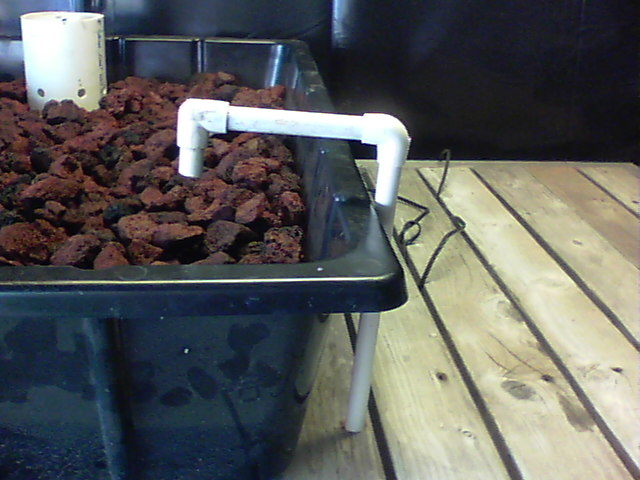
I am using Lava rock for the first base and then will add expanded clay to the last 3 inches of my bedding trays. I could have went to the creek and got some  creek pebbles, but It was just easier to go to the garden center.


The system was then filled with water and ran for a couple days to make sure the chlorine was out and it was going to work ok before I placed the fish. For testing purposes and it was also going into winter I decided to go with local fish to start and then change them out to Tilapia come spring. You can read how to properly cycle your fish here on the blog if you are wanting to do it correctly.


The fish I chose were simple perch, and one crappie just happened to get caught so its in the tank too.

I feed them worms and crickets twice a day, they are very active.

This will I think pacify me for now until I can build bigger. I have so many plans for the system I sometimes lose sleep.  Buts that's what makes it nice. There is no wrong way to do it, just a better and more efficient way in doing it.

Please like share and subscribe to my blog and You-Tube Channel.

Any Question on what I did, feel free to ask.


I will add a video and some more pics soon.


Tuesday, November 20, 2012

How to Cycle Aquaponics

Starting Up (Cycling) Your Aquaponics System

 This article was borrowed from our friends at The Aquaponics Source

Bacteria are the carburetor of an aquaponics system that takes the otherwise unusable fish waste and creates a near perfect plant fertilizer. In this article I will demystify the process of establishing a beneficial bacteria colony in your aquaponics system. This process is often called system “cycling”. By the end of this article you will fully understand what you MUST do to initiate cycling and to ensure its success. You will also understand what you CAN do to both make the process less stressful for your fish and your plants, and to speed up the process.

What is Cycling?

Aquaponics System cyclingCycling starts when you (or your fish) first add ammonia to your aquaponics system. Ammonia (chemical formula NH3) is a compound made of nitrogen and hydrogen. It can come either from your fish or from other sources. Ammonia is toxic to fish and will soon kill them unless it is either diluted to a non-toxic level or converted into a less toxic form of nitrogen. In addition, nitrogen in the ammonia form is not readily taken up by plants, so no matter how high the ammonia levels get in your fish tank; your plants will not be getting much nutrition from it.
The good news is that ammonia attracts nitrosomonas, the first of the two nitrifying bacteria that are present in the air and will populate the surfaces of your system. The nitrosomonas bacteria convert the ammonia into nitrites (NO2) (the golden line in the chart above). This is a necessary step in the cycling process; however, nitrites are even more toxic than ammonia! But there is good news because the presence of nitrites attracts the bacteria we are truly after – nitrobacter. Nitrospira convert the nitrites into nitrates (represented by the green line in the chart above), which are generally harmless to the fish and excellent food for your plants.
Once you detect nitrates in your water and the ammonia and nitrite concentrations have both dropped to .5 ppm or lower, your system will be fully cycled and aquaponics will have officially begun!

The Importance of Testing Tools

API Freshwater  Master Test Kit
API Freshwater Master Test Kit
You must have some way of telling where you are in the cycling process – typically a four to six week endeavor. Specifically, you must monitor ammonia, nitrite, and nitrate levels as well as pH so that you know that all these elements are “in range”. If they are not, you may need to take corrective action. This is also the only way that you will know when you are fully cycled and ready to add your fish. Plus, watching the daily progress of the cycling process is fascinating and something you can only see through the lens of a test kit. By the way, once you reach the point that your system is fully cycled, you will need to do much less monitoring than during the cycling process. So get through the cycling process and look forward to reaping the fruits (… or should we say the fish) of your labor.
To do their testing, most aquaponic gardeners use a product by Aquarium Pharmaceuticals Inc. called the API Freshwater Master Test Kit. This kit is easy to use, is inexpensive, and is designed for monitoring the cycling process in fish systems.
You will also need a submersible thermometer to measure your water temperature. Temperature affects both the cycling rate and the health of your fish and plants once you are up and running. See more on this below.

Starting the Cycling Process

Once you have your aquaponics system set up and your test kit in hand all you need to do to start the cycling process is add a source of ammonia. Traditionally this has been by adding fish and letting their waste be the ammonia, but I’m not a big fan of using fish as an ammonia source. Instead I prefer a technique called “Fishless Cycling” where an external source of ammonia is added to your aquaponics system. Why is this?
Nitrogen Cycle
Typical Nitrogen Cycle
First, both you and your fish will likely experience much less stress because you will not be trying to keep anybody alive during the process. Second, you can more precisely control how much ammonia is added to your system during the process. For example, if you see that your ammonia level is creeping up to 8 ppm, but no nitrites have shown up yet, just stop adding ammonia for a few days and let the bacteria catch up. You can’t do this with fish!

The practical result of this is that with Fishless Cycling you can fully stock your tank once cycling is complete, versus gradually increasing your stocking levels as is recommended when cycling with fish. This is especially beneficial to those who are growing aggressive or carnivorous fish because they are less likely to attack each other if they are all introduced to the tank at the same time.

Cycling Without Fish

There are several ways to add ammonia to your system, but honestly the best is to simply purchase our Cycling Kits.  They come in 3 sizes – Small (< 100 gallons), Medium (100 – 300 gallons) and Large (300 – 500 gallons).  They come with all the ammonia you will need to fully cycle the corresponding size tank, powdered seaweed to provide a rich supply of micronutrients to get your plants off to a great start, and detailed instructions.
With Fishless Cycling you can add safely fish to your aquaponics system after your ammonia and nitrite levels drop to zero, or close to it, and you have measurable levels of nitrates.  This tells you that both the ammonia converting bacteria (nitrosomonas) and the nitrate converting bacteria (nitrospira) have become fully established and are ready to efficiently process fish waste.

Speeding up Cycling

Unfortunately nitrifying bacteria are some of the slowest growing bacteria in nature, and the cycling process can take as long as six weeks. There are a few things you can do to speed up this process, however.
• Temperature – like most microorganisms, nitrifying bacteria multiply more quickly in warmer conditions. Their optimal temperature is between 77-86°F (25-30°C). At 64°F (18°C) their growth rates is decreased by 50%. At 46-50°F (8-10 °C) it decreases by 75%, and stops all together at 39°F (4°C). It will die off at or below 32°F (0°C) and at or above 120°F (49°C).
• pH – Bacteria prefer a pH range between 7 – 8. Use hydroponic pH up and down products to keep your pH in this range during cycling.
• Oxygen – Nitrifying bacteria are aerobic and will multiply much faster under highly oxygenated conditions. Even if you are cycling without fish be sure to have as much oxygen in your tank water as you would if the fish were there. Think of the bacteria as just another living organism that requires oxygen in your system.
• Adding bacteria – You can “jump start” the process by adding bacteria from an existing colony. Good sources of beneficial bacteria are ranked here, leading with the best (the lower you go on the list the more chance you have of introducing a disease into your system):
  • Our Microbe Lift Nitrifying Bacteria product (included with the Cycling Kits)
  • Media from an existing aquaponics system.
  • Filter material (floss, sponge, biowheel, etc.) from an established, disease-free aquarium.
  • Gravel from an established, disease-free tank (Many local pet and aquarium stores will give this away if asked.).
  • Other ornaments (driftwood, rocks, etc.) from an established aquarium.
  • Squeezings from a filter sponge (any pet and aquarium store should be willing to do this…).
  • Rocks from a backyard pond with fish in it.
  • Rocks from a river, lake or wild pond.

When to add plants

MaxiCropWe recommend adding plants as soon as you have started the cycling process.  The reason for this is that it gives the plants some time to put down roots and establish themselves before the fish are introduced and nitrates need to be absorbed.